What's in my backpack: the photography gear I use

I've written a lot on this blog about the photography equipment I use, but almost always about lights, modifiers, and how I position them on set. Lighting has a huge effect on the final image. I certainly wouldn't say the same about the camera, at least for work published online. That's why I've always avoided writing at length about my camera body and lenses. Still, I get plenty of questions about what's inside my camera bag, which is why I made the captions below every photograph on the blog more detailed a few months ago. They obviously don't cover everything, so today I'll try to explain why I use this particular gear and why buying the same things would be a poor choice for most people.
I've owned most of it for several years, so I've had enough time to form an opinion. If something didn't suit me, I've probably replaced it already. This isn't an industry where everything becomes obsolete after a year. My most important lens was designed almost 20 years ago. Spending more money here therefore makes more sense to me than it does with many other purchases.
Note: I use all of this for a very narrow purpose, exclusively for photographing models (and even then within a fairly limited range, almost always under artificial light). I don't take a camera backpack when I travel, and I don't spend my free time photographing sports or reportage. Even at a family gathering, I'd sooner use the camera in my phone. Most people use their cameras much more often and for a far wider range of photographs. In that case, my equipment may not work at all, and something else, often much cheaper, may be a much better choice.
I wrote about how to choose equipment some time ago (link). Today I'll focus on what I use.
What's inside the camera bag
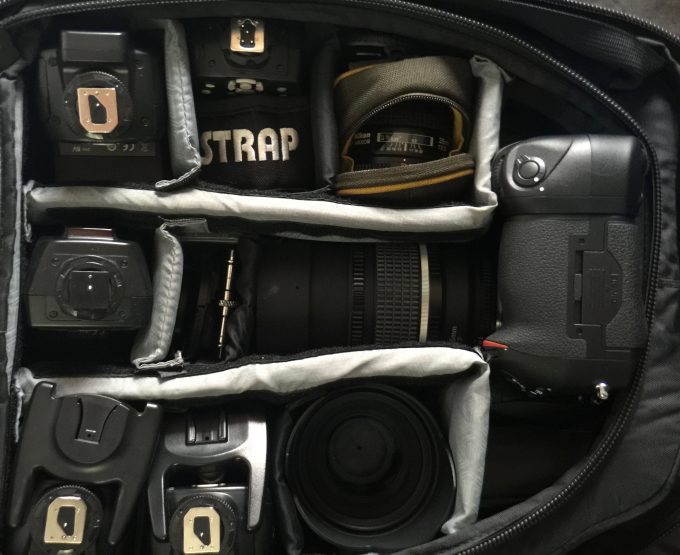
Three lenses, a camera, several flashes, and assorted bits and pieces
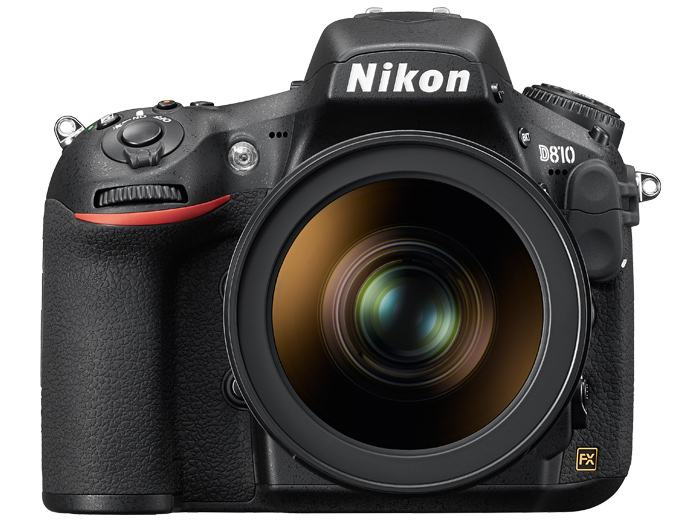
Nikon D810 camera Almost all the photographs on the blog, however, came from my previous Nikon D700 (if it had more pixels, I'd still be using it). I also did a few shoots with a Nikon D90. Back to the D810: it's Nikon's best camera for photographs like mine, so in theory the choice was very simple. If I didn't already own any lenses and were building a system from scratch, though, I'd buy a Sony A7R II. It's lighter, far better for video, and works with Canon lenses and lenses from other companies. Nikon lenses without built-in motors wouldn't have autofocus, however, which is ultimately why I stayed with Nikon. I'd also consider the Canon 5DS R.
Whatever camera I bought, a battery grip would be mandatory. I take almost nothing but vertical photographs, and a grip makes that much more comfortable. I bought the original MB-D12. Probably unnecessarily, since third-party grips frying camera electronics are largely a thing of the past, as are screws that snap. Still, I preferred not to take the risk.
Nikkor 135mm f/2D DC lens I use it for all my beauty photographs and nothing else. I bought into the entire Nikon system specifically for this lens. It has a unique Defocus Control function that gives you additional control over depth of field. It sounds fantastic, except that outside of tests, I haven't used it once. It would probably be more useful for portraits than beauty. Its brightness doesn't matter to me either because I use at least f/7.1.
The Nikkor 135mm f/2D DC is considered an unusually “soft” lens. That's an advantage for portrait photography but a disadvantage where sharpness is the priority, such as macro.

It also has plenty of faults: no built-in autofocus motor, enormous chromatic aberration, and almost every copy needs a very strong front- or back-focus correction. Fortunately, none of that matters for how I use it. Nikon still hasn't managed to make anything better, despite this design being almost 20 years old. If I shot reportage and other kinds of work, I'd probably choose something else. For beauty, it's ideal.
Today I know that if I'd chosen another brand, such as a Canon, Zeiss, or Samyang 135mm, I'd probably be just as happy. It would definitely still be a 135mm lens (or 85mm on a non-full-frame camera), because I really dislike the distorted perspective of close-range shots. Using shorter focal lengths and cropping away a mass of pixels every time isn't a particularly good idea either.
An example photograph taken with this lens:

f/7.1
Sigma 50mm f/1.4 EX DG HSM lens I use it for almost every other shot. I have nothing to complain about. It works and causes no trouble. The only issue is that autofocus doesn't work while filming, so it would be awkward for vlogging (although autofocus isn't used in normal filmmaking anyway, which I finally came to understand).

There's now a newer Sigma 50mm Art, and that's what I'd choose today. Since I already have a 50mm, however, I feel no need to replace it.
An example photograph taken with this lens:

f/7.1
Nikkor 35mm f/2 AF-D lens Another fairly old design, with optics dating from 1989. I hardly ever photograph with it, although that's because the focal length isn't very useful to me. It's fine, but it has its flaws. There's no built-in motor, autofocus works considerably worse than on any other lens I've owned, and manual focusing is uncomfortable. Its advantage is the reasonable price.

Eventually, I intend to use this lens for many more outdoor shoots, which is why I bought it. On the other hand, at this focal length, very wide apertures can sometimes be useful outdoors, closer to f/1.2 than f/2.0. If I were going to replace anything in my kit, it would be this lens. Since I use it so rarely, though, that probably won't happen soon.
An example photograph taken with this lens:

f/6.3
YongNuo YN flashes I first used several YN-460II flashes, then added the YN-560 IV. They're my favorite speedlights for off-camera flash. I've used them for plenty of shoots, and they have often supplemented my studio lighting. I never mount them on the camera.

The 560 IV has a built-in radio receiver, and all its settings can be changed remotely using either a dedicated transmitter or another flash. Its power is similar to that of top system flashes, yet it costs a small fraction as much (I paid PLN 220 each). These are manual flashes, so they don't support TTL or high-speed sync.
I also have a YN560-TX controller, which can adjust the settings of up to six groups of YN-560 IV or III flashes. I use it to trigger studio lights fitted with YongNuo RF-602 receivers too.
An example photograph made with three YN flashes: one in front of the model, one behind her, and one inside the sphere:

Accessories
X-Rite ColorChecker It's used to reproduce real colors in photographs more easily. X-Rite's own software gives poor results, so you need to use Adobe's software instead.

I'm still testing it, but I already know I bought it many years too late. Not because it speeds up my work so much. The Nikon D810 simply handles color brilliantly with its factory profile, which couldn't be said of my previous camera. The ColorChecker would have been more useful with that one. It's also a great option for people who own several cameras. I'll write more about the ColorChecker in the future.
Marumi Digital Grande Light Control 8 circular neutral-density filter For outdoor photography in strong light. Today, I'd probably buy one that darkens the image less (or one with adjustable strength), sized for my largest lens, plus step-down rings for the smaller ones. Alternatively, I'd buy a Cokin filter holder and a square filter. The advantage would be the ability to use both the filter and a lens hood on every lens, which isn't possible with adapters for circular filters.
Color gels for speedlights Two identical sets of gels for changing the color of speedlight output, in all sorts of colors. Some match flash color to the ambient light; the rest are purely for effects, such as red and blue. I attach them to the flashes with Velcro. I use them very, very rarely, but they need to stay in the bag just in case.
Other bits and pieces That means lens caps, spare batteries, flash stands, a strap I almost never use, pieces of film and fabric to hold in front of the lens (also almost never used), and so on.
Backpack Dakine Mission Photo Finally, a word about what I keep all this in. I've owned a Dakine Mission Photo backpack for many years. Its unusual feature is that it contains a separate bag, with all the photography equipment inside that. You can remove the bag and use it independently of the backpack. It certainly isn't comfortable to carry, but it can occasionally be useful. Everything is accessed from the side against your back. I chose this model for a strange reason. At the time, I traveled exclusively on a sport motorcycle and needed a backpack capable of protecting its contents in a hard impact.

Before that, I used an unusual, purpose-built motorcycle backpack, the Axio Swift 2.0 (I described it here), with a tiny camera bag placed inside. It was completely impractical, and there was no way to fit everything I needed. It definitely wasn't a backpack designed for photographers. I also once wrote a longer piece about the Dakine Mission Photo, which you can read here.
When I have to go somewhere with a camera, I don't take the backpack. Usually, I take only the body with the 50mm and nothing else. If I need anything more, I pack it in a Promate Xplore-M bag. I've used it so little that I can't say anything about it beyond the fact that its size and design suit me.
Summary
As you can see, I don't have many lenses, and all of them are primes. I used to own more, but they were unnecessary. Many people consider the camera I use excessive for reportage and various other applications because it produces such heavy files, but it's excellent for studio photography. I do think Nikon has a great deal of catching up to do with Sony when it comes to adopting new technology, although I'd need to spend time using Sony's equipment to confirm that opinion.