Strobing on a budget and continuous vs. flash lighting
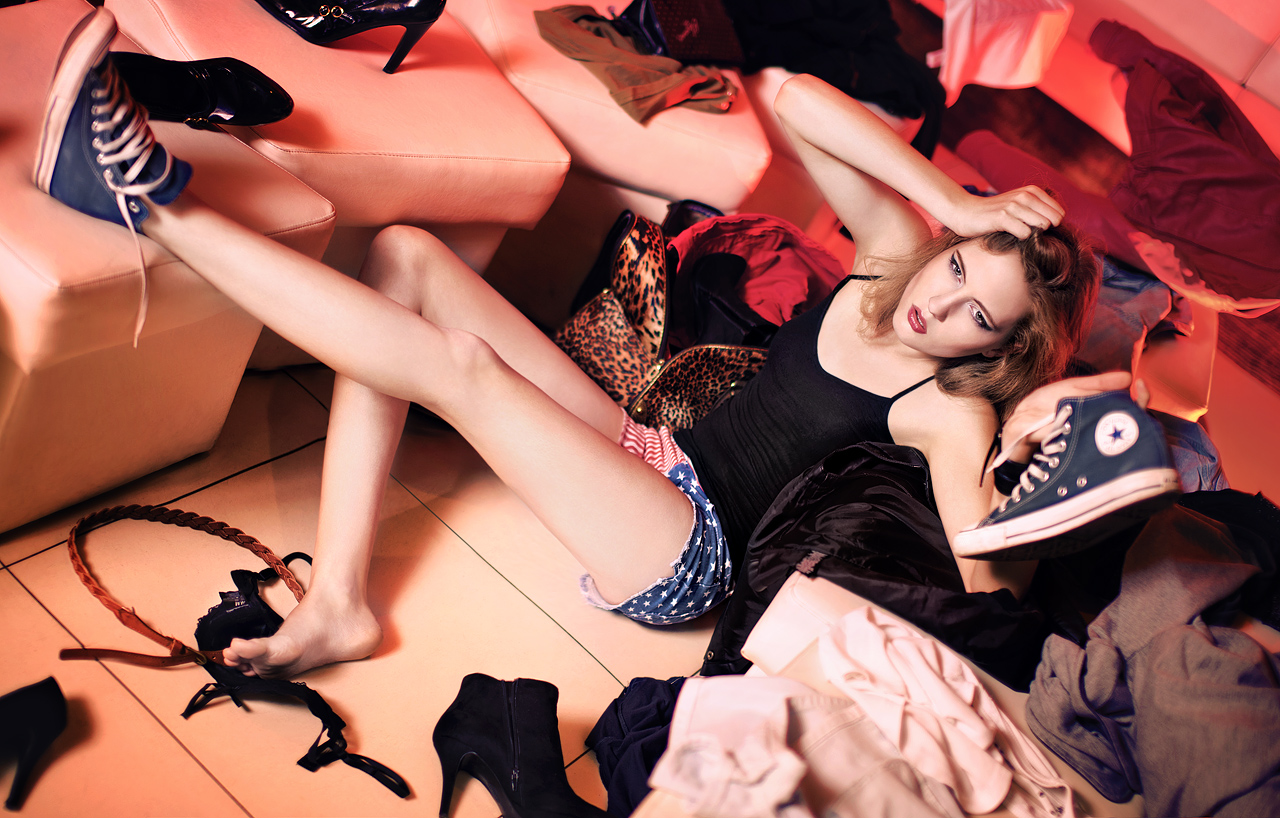
If you want to photograph people, sooner or later you will need to start using lights. I do not mean one built into the camera or mounted on it. Today I am covering equipment, specifically strobing: photographing with speedlights placed around the set rather than on the camera's hot shoe.
I took every photograph of a model in this post exclusively with the lights described here. I will discuss some of these photographs in more detail in later posts, or have already done so.
Besides being mobile, this kit was also very cheap. There is no great problem if you need one flash and triggering it with an optical slave is enough. Things get worse when you want more of them. The kit I am writing about costs PLN 1,000 and consists of three speedlights with light stands, very simple modifiers and radio triggers. Everything is new. These were not flashbulbs, either, but fairly powerful speedlights for this category, with seven-stop power adjustment, a built-in optical slave with an option to ignore pre-flashes, and a head that rotates sideways and tilts upward. Speedlights are the kind of flash you would normally put on a camera's hot shoe. The lights in question are the Yongnuo YN-460II, which caused quite a stir at the time and, in fact, still do. The Roman numeral II at the end is very important because the first revision is poor. The kit even included a plastic stand, a diffuser and a fabric case.

I still have them and use them on every shoot, just like the other parts of this kit: the stands, triggers and umbrellas. They continue to serve me well and, in some situations, studio strobes cannot replace them. One of these flashes costs around $50 including shipping to Poland, or about PLN 200 when bought directly in Poland. There is also the YN-560, a model with similar power but more advanced features.

A comparison of three models. Photograph from camcrunch.com
The YN-560 has zoom, a PC sync port, a better optical slave, an audible signal and support for a battery pack. Unfortunately, it used to cost twice as much as the 460II, although the prices on eBay are now similar. There is also the YN-560II, which adds an LCD. I do not know whether its power was increased, but a price almost 50 percent higher means I probably would not consider it for a budget kit.
All these flashes are manual, so you have to set their output by hand. They do not support TTL, but that is no drawback here. This kind of photography uses manual settings anyway. How could the flash automation know how much light you want on the hair, whether you prefer a lighter or darker background, and so on? All the automation will do is prevent the photograph from being underexposed or overexposed. If you cannot handle that yourself, you still have a lot ahead of you. One undeniable advantage of lighting with automation is that you can set the flash power manually through the camera menu. You do not have to walk over to the flash whenever you want to change its output. That can be a considerable advantage when you are alone with the model. But if you have an assistant, or simply anyone else nearby, even a makeup artist who has already finished the model's makeup, that advantage matters less. You also have to remember that a flash you can control from the camera costs something entirely different from the lights I am describing.

Klaudia Danch/Brick club in Tarnowskie Góry (2 x YN-460 II + ambient light from the window in the background) 135 mm | F/3.5, 1/200s, ISO 100
Remember that I am still talking about new flashes. On Allegro, you can buy old used models from various companies, sometimes for even less. Unfortunately, they are usually less powerful and lack a built-in optical slave. Their power adjustment also varies. You have to be careful because flashes used in the days of film cameras had high trigger voltage on the hot shoe, and not every radio receiver can handle it.
An interesting fact: the first electronic flashes appeared across the Atlantic during World War II. They reached Europe in the 1950s. Before that, photographers used something similar to flashbulbs, but they were disposable. A wire made of aluminum or magnesium burned up during the flash.
I knew nothing about light stands and brackets at the time, so for around PLN 120 I bought a reporter kit: a stand, a speedlight bracket and a shoot-through umbrella. Allegro is full of them. At this price, the stands are made of very thin tubing, but that has its advantages. They are light and fit into a small case. I can pack four such stands into one small case, two in the sections intended for stands and another two in the umbrella sections. The umbrellas still fit between the stands. Incidentally, cases closed with a plastic snap buckle are much more practical than ones closed with Velcro. The problem with these stands appears when you need to use flash outdoors in the wind. Then you should probably have something sturdier, such as a Quantuum Air stand, which gets very good reviews and costs PLN 100, or simply invest in proper stands. But since today we are talking about cheap equipment, we are not talking about proper equipment.
Three of these cheap reporter kits plus three flashes came to around PLN 800. The remaining money went on radio triggers from the same company, the Yongnuo RF-602. A newer version is now available, the RF-603, in which each trigger is also a receiver. This means you put exactly the same device on the flash and on the camera's hot shoe. There is no fear that if the transmitter dies, you will be left without a spare. You simply take another unit from one of the flashes and put it on the camera. At this price, it is brilliant. It will not let you control automatic flashes from the transmitter or use flash at fast shutter speeds, but, as I have already said, today's setup is meant to be cheap.
Someone might ask why you should buy radio triggers when the built-in optical slaves can trigger the flashes. Yes, they can, but it is completely impractical because the flashes must be able to "see" each other, and the camera must also fire some kind of flash, even the built-in one, which you can cover with a filter. It gets worse if a flash is behind you. You do not need a radio receiver on every flash, but it would be good to trigger at least the main one this way. Then you can concentrate on positioning the lights properly instead of making sure they can "see" each other. The radio trigger I mentioned has a hot shoe, so you simply slide the flash onto it and you are done. Some radio triggers only have a PC sync socket, a jack socket or something else. In that case, you connect the flash to the radio receiver with a cable. You can also connect the camera directly to the flash with a cable. It is a nice option... until the model trips over it for the first time... Even so, with current radio-trigger prices I would not consider using a cable at all.

Klaudia Danch, characterization: Karolina Zientek (2 x YN-460 II). You can see a description of the entire shoot here. 135 mm | F/5.6, 1/200s, ISO 320
I also had a Metz 58 AF-1, which could be controlled remotely from the camera. It was worth more than everything listed above combined. Even so, I found the Yongnuo flashes much more convenient for strobing. They were easier to use, and I did not have to worry as much if a stand and flash fell over. The YN flashes also have an optical slave, while the Metz does not, so if you want one, you have to buy a hot-shoe adapter with an optical slave. I had the Metz 48 AF-1 too and actually remember it more fondly than the 58, still speaking only about strobing. It was simply easier to use, though that was largely because it had far fewer features. I still reached for the Yongnuo most often.
A silver-and-gold reflector made from an emergency blanket, available from a pharmacy for a few złoty, completed the kit. I definitely do not recommend this. The quality is terrible, even compared with the cheapest reflectors from China. It also produces much harsher light because its surface is more mirror-like. Chinese reflectors are cheap, so it is worth getting at least one. For portraits, it is best to have white on one side and silver on the other. Personally, I use the white side almost exclusively. I will write more about reflectors another time.
If you do not already have rechargeable batteries, you also need to add their cost, along with a charger. White Sanyo Eneloops offer excellent value for money. Each flash takes four AA batteries.
Strobing
Can you take photographs with a kit like this? Definitely. Is it suitable for everything, and can it replace studio lighting? Definitely not. Insufficient power will certainly be a problem for anyone working at small apertures. You can assume that one of these flashes is just over 2 EV less powerful than a typical low-budget 300 Ws studio strobe, and even 300 Ws is often far too weak for small apertures. A speedlight also spreads light differently from a studio strobe. It throws the light much more directly forward. In practice, this makes it harder to light a large softbox or even an umbrella evenly because the light will be stronger in the center than at the edges. With a modifier around 80 cm across, it does not matter much, but at 120 cm the edges will receive considerably less light than the center. The greatest light loss will occur with a beauty dish, although hardly anyone uses one with flashes like these.

Idalia Zbrzeźniak (Eastern Models), makeup: Karolina Łukaszewicz/Brick club in Tarnowskie Góry (2 x YN-460 II + red filter). You can see a description of the entire shoot here. 24 mm | F/2.8, 1/200s, ISO 200
It is also worth thinking carefully before buying softboxes and other modifiers designed for speedlights. It is probably better to invest in accessories for studio strobes with the popular Bowens mount. You then need an adapter that lets you use speedlights with those modifiers. This way, you will be able to use everything you buy with studio strobes in the future. Even if you choose strobes with a different mount, you will only need the right adapter.
Continuous vs. flash lighting
You can also put together a cheap kit with continuous light instead of flash. At first, almost everyone probably thinks continuous light makes photography easier. You can see the final effect live, and perhaps that really is helpful... if you are shooting film. There are, of course, situations where a modeling light, as found in studio strobes, would help. But in the age of an LCD on every camera, you can take a few extra test shots and set the lights perfectly that way. Flash also does not produce as much heat, so you do not need expensive modifiers. You can simply mount several flashes next to one another without worrying that the softbox will be ruined or the location will go up in flames. Flash does not blind people continuously, either, and the model's makeup will not start running because of the high temperature.
Another major advantage of speedlights is their size and battery power. You can use them the way I did in the photograph below:

Klaudia Danch, makeup: Karolina Zientek, hair: Le'Prestige (3 x YN 460II). You can see a description of the entire shoot here. 135 mm | F/10, 1/200s, ISO 200
A flash was placed inside the sphere. It fit without much trouble, and there was no need to worry about running a power cable. You will find a description of this shoot in the previous post. Outdoors, you also do not need to worry about mains power. The whole kit is light and mobile.
There is one more option: flashbulbs. Unfortunately, they offer no power adjustment, which rules them out. You can move a bulb closer to or farther from the subject, but that is no solution because you are then changing the lighting completely, not just its power.

Klaudia Kandziora/Brick club in Tarnowskie Góry (1 x YN 460II) 50 mm | F/5.0, 1/200s, ISO 200
Summary
I certainly do not consider continuous light an alternative to flash. Not in this field of photography. For this kind of work, continuous light has nothing but disadvantages. We are also talking about a budget kit, and continuous-light modifiers are far, far more expensive than flash modifiers. Continuous light makes sense in other kinds of photography, especially when you can extend the exposure time as much as necessary. For photographs of people, it is a completely pointless solution. Flash prices are now so reasonable that this is what I suggest looking into. PLN 1,000 for a NEW kit consisting of three flashes, each with radio triggering, is a very good option. You can, of course, find something even cheaper, but you have to be ready for greater compromises.