Milestones in My Photographic Development. Gear: My 10 Most Important Purchases

Many things can give you a serious boost while learning photography, and some of them can be bought. It will probably be something different for everyone and largely depends on what you photograph. I made a list of the things that mattered VERY much to me. I only mention equipment here, but a separate post about intangible things may appear in the future.
Everything on the list below had a huge effect on my photos. Not necessarily by making them better. It simply gave me new possibilities that let me learn new things or made it much easier to do what I wanted.
My first serious camera
If the cheapest DSLR with a kit lens can be called that... It was simply the very beginning of photography for me, and that purchase made me start taking photos instead of putting it off until later, which often ends up meaning "never". At the time, I thought I would buy one of the cheapest "camera + lens" kits and it would last me for years. Perhaps I would buy one more lens, and that would be it. Flash? NEVER. Not only do you have to put it in the right place, you also need to choose the right power, height, and tilt angle for each light, then put all of it in softboxes or something. It was black magic to me then. But who needs flash when there is a sun, right?
My first speedlight and a stand for it
A sensor that could not cope with low light at all quickly changed my mind. At least partly. I needed a flash to make the photos bright, not to make them good. I bought one with full automatic control. At first I used it on the camera, while trying to work out how to diffuse the light with at least a sheet of paper, bounce it off something, and so on. Even so, I would never call this an important stage in learning photography in any respect.
That moment came only when I started putting the flash on a stand, which was exactly what I had assumed I would never, ever do... I kept using a translucent umbrella as the modifier, mainly because I had no money for anything else. Today I would divide the budget differently: buy a cheaper flash and at least an octagonal softbox to go with it.
I controlled and triggered that flash with Nikon's built-in CLS system. It used infrared, so the flash had to see the camera, or something nearby had to reflect the signal. A badly crippled solution.
My first fast lens
A DSLR without good lenses is worthless. That was what everyone said. I assumed they were exaggerating...
I had an 18-55 mm F/3.5-5.6 kit lens. As long as I photographed only stationary motorcycles, I was happy with it, largely because I did not know what my photos would look like with a better lens.
I bought a faster lens only because a friend would not leave me alone, constantly telling me how useful a 50 mm F/1.8 prime would be. Only after I had one did I begin to understand the obsession with buying the fastest possible lenses. That said, I would not buy that lens a second time. I would prefer 35 mm + 85 mm. I did not have a full-frame camera then; for full frame I would take 50 mm + 135 mm. But that expense was out of the question at the time, and the 50 mm was supposed to be the last thing I ever spent money on in photography...
Pen tablet
For the kind of photos I make, a pen tablet speeds up editing so much that I cannot even imagine going back to working without one. I would simply change careers rather than struggle in Photoshop with a mouse or touchpad. I had already heard how useful a tablet was, but once again it only sank in after I tried one myself and learned to use it. I bought the cheapest Wacom because the next model up was far too expensive. I replaced it with a professional series only after several years.
More speedlights
They finally let me focus on how to light the set rather than how to work around the limitations of having only one flash. At first I still had no idea how to arrange those additional lights, but at least I could finally practice.
My additional flashes did not support CLS, so I triggered them with optical slaves. The new flashes were completely manual and very cheap, so if they fell off a stand or got a little wet, it was no great loss.
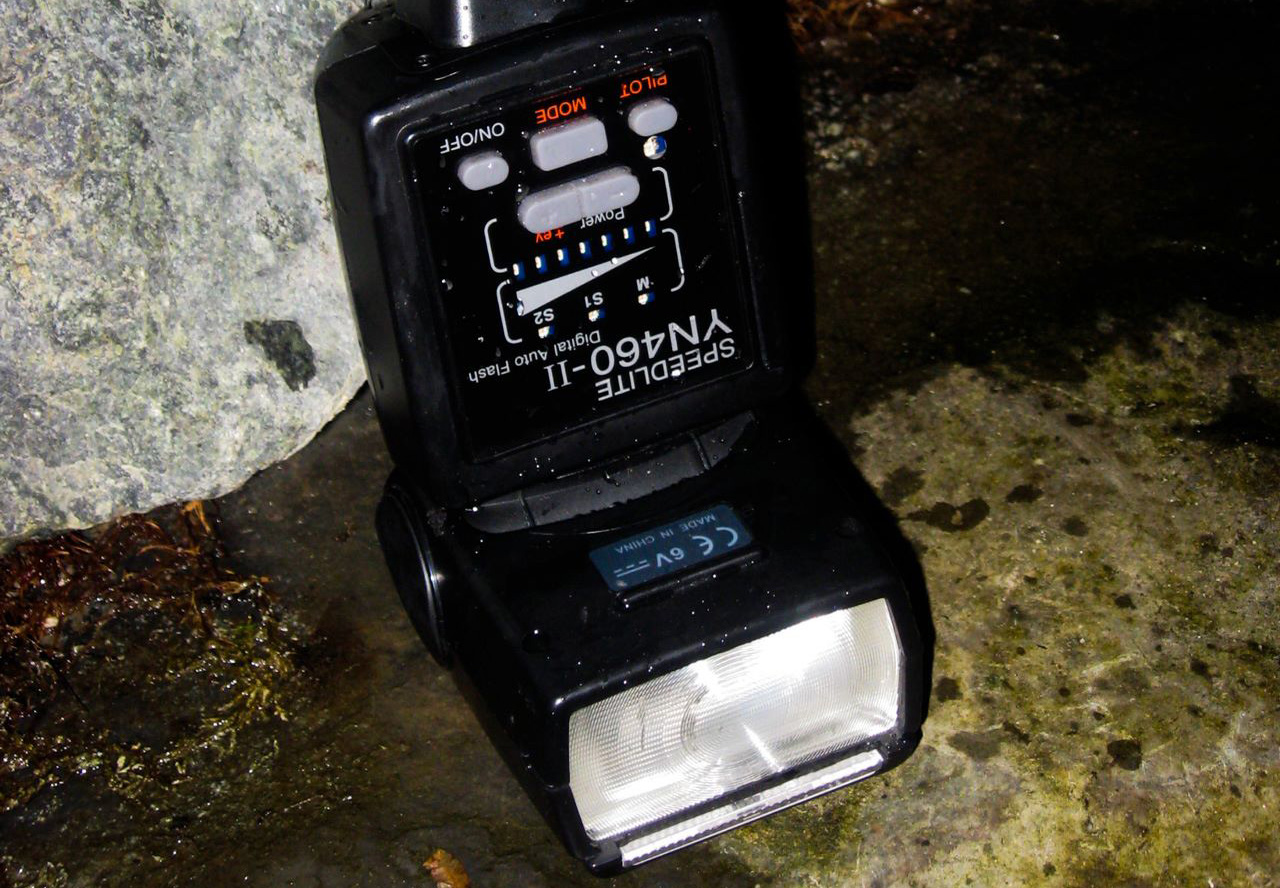
Today I use only that kind, just a newer model, plus studio lighting of course.
Radio triggering
Both infrared and optical triggering have the same problem: the transmitter, meaning the camera, and the receiver, meaning the flash, need to see each other. It worked somehow with one light, but caused problems with several. So I moved to radio triggers. Unfortunately, to change a flash's power I had to walk over to it and use the buttons on its body. Even so, I preferred this method and the certainty that every flash would always fire.
Technology moved on later, and now I can set the power of every light from the transmitter.
Boom stand
As soon as I started photographing faces, I realized that for straight-on shots I prefer very symmetrical lighting with one main light. The problem was that the stand holding the light was usually directly in front of the lens, and it was not always possible to solve it in the way shown below:

I needed a boom stand. Unfortunately, my budget would not allow it, so I assembled one from the stands I already had, joining two of them with a reflector holder.

I eventually abandoned the homemade version in favor of a factory-made boom with wheels.


My first studio light and Beauty Dish
I had read a lot about how magical the beauty dish was. I finally wanted to try using one, but saw no point in doing it with speedlights. They were too weak, and using them at full power required breaks to let them cool down. So when I decided to get a beauty dish, I bought a studio light at the same time.

The cheapest pseudo-brand model, which later turned out to be a mistake. It was not powerful enough at 200 Ws, and it was terribly made. It did not take long to fall apart, but fortunately I "fixed" it:

Graphics monitor
I have already written so much about monitors that there is no point adding anything :). I could finally see what my photos really looked like, and editing them made more sense.
135 mm lens on full frame
With my APS-C camera I had a 50 mm lens for portraits, and it was definitely not what I wanted. I did not like that focal length at all. When the time came to move to full frame and replace my lenses, I could buy a typical 135 mm portrait lens, the very frequently recommended 85 mm, or perhaps a 105 mm. By then I knew with absolute certainty that I wanted 135 mm at any price. "At any price" can be taken very literally here, because it was unfortunately the most expensive option and almost unavailable at the time. I called every store in the country until someone finally checked where the last unit in Poland had gone. Those lenses later vanished from the market for so long that people predicted production had ended, but they became available again.
Back to the 85 mm: I simply do not like it. It is only moderately useful for very close shots, while from a little farther away you have to worry more about the background than with a 135 mm, which matters when you use a reflector as the background. On APS-C, however, I would choose the 85 mm.
That lens was very important to me because portrait frames made up more than 90% of my photos at the time. They are still the largest group today.
To sum up
I was not aiming for a round number. It simply turned out that there were exactly 10 pieces of equipment I had bought that I could call breakthroughs. I spent some of my money poorly back then, for example by buying the top model of system flash even though one ten times cheaper would have worked just as well on a stand. Buying the cheapest studio light, meanwhile, quickly came back to bite me. I also bought lenses I did not need at all, such as Sigma's 28-70 mm F/2.8. I simply did not yet know exactly what I needed. Things are much easier when you have specific requirements.
Upgrading to better and better equipment mattered little. The important thing was to have anything at all from a given category so I could test how it worked and what I could do with it.