Peak Design Everyday Messenger - a bag unlike any other

The Peak Design Everyday Messenger was intended to be the best camera bag in the world. Brilliantly designed and made only from very high-quality materials. But half of all manufacturers describe their products that way, and I doubt anyone believes such assurances anymore... In this case, future users agreed with the claim. The Messenger raised 5 million dollars on Kickstarter, meaning it generated that much revenue before production even began. Its design is interesting and different from competing bags. I have owned it for half a year, so I decided I could finally describe my experience. During that time, I also used other Peak Design accessories, including the Capture clip, which allowed me to carry a DSLR on my belt.
Contents
- Introduction
- What do I use Peak Design products for?
- Peak Design Everyday Messenger: what is all the fuss about?
- What I fit inside
- Field Pouch
- Capture (Pro)
- Lens Kit
- Summary
What do I use the Peak Design bag for?
As with other things I cover, this will not be a test but my subjective impressions from using it. While I was in Poland, I took the Messenger bag to photo shoots. Apart from a camera and lenses, I packed quite a few speedlights inside and attached a stand to it. I also put the Peak Design Field Pouch in the bag, which works well for carrying various small items. I will give it a separate section.
After my stay in Poland, I returned to Bangkok and took the Messenger with me. Here, it accompanies me around the city with different contents from what I carried to shoots, most notably without lights, duct tape, and the other things essential during a shoot.

This is the Peak Design Everyday Messenger with Aleks, with whom I am preparing a feature about modeling in Asia
I also often used the Everyday Messenger not as a camera bag but as an ordinary bag for everything I needed on short, non-photographic trips. At the turn of August and September, I drove thousands of kilometers this way. At the end of last year, I went to Hua Hin and mixed photography gear with everyday items. This is practical because the camera and lenses can be attached to the outside of the bag when necessary instead of going inside. This is done with the Peak Design Capture clip, which will also get a separate section. I took two of these clips. I can keep one permanently on my belt or backpack and another on the bag, with no need to move it.

Peak Design Messenger: what is all the fuss about?
The materials used to make it really are excellent quality. The exterior is waxed 500D Kodra, so water resistance is another advantage. But that is not why this model generated so much interest. The interior construction is simply quite interesting and different from the norm. That is exactly why I decided to test it. At first, thinking it was a bag like any other, I intended to decline the offer to try it. I had never planned to introduce this sort of accessory coverage on the blog, but this time my own curiosity made me take an exception.

Instead of making another camera bag based on the same old patterns, Peak Design reinvented it to some degree. But let us not exaggerate. The overall shape is standard, you carry it on a shoulder strap like any other bag, and at first glance it does not stand out.
Above all, the way the interior is configured has changed. Instead of standard dividers, there is something like origami. The Velcro dividers fold in different ways, so you can reconfigure the inside quickly, or put in a lens and fold a divider so it bends just above it and covers the front element. If the lens is short, you can place something else on top. I did that almost every time.

Source: manufacturer's materials
This has a major effect on how you use the bag and makes it easier to pack things sensibly right up to the top. You also do not have to detach dividers and fasten them elsewhere every time you want to carry something different. At least with what I carried, I never had to.
Another interesting feature is the way the main compartment closes. This is hard to describe because I have never encountered a fastener like it anywhere else. Peak Design used something like a latch combined with a magnet, mounted on a very strong and slightly flexible strap. This makes it very quick and easy to open and close in a way that practically prevents it from opening by itself.

The latch can close in four positions, depending on how full the bag is. If it is almost empty, it is much more compact when closed than when full. The 13-inch version has a capacity of 6 to 14 liters. This works perfectly. Unfortunately, I definitely overdid the practice of forcing it closed to make the bag as compact as possible. With my basic kit inside, I could close it on the second catch without any trouble or wrestle with it a little and close it on the third. Unfortunately, after four months of constant forced closing, the rivets holding the catch gave up. I have mixed feelings about this. On the one hand, I realize it was largely my fault. On the other, slightly stronger rivets would have prevented the problem, although that would have affected the design because the entire catches would have needed to be thicker.
There is a zipper on top of the bag. Opening it lets you take out a camera quickly, for example, without opening the whole thing.

It is very practical, but not when I have the battery grip attached to the camera. Then the camera becomes too large to pull out comfortably.
You can also attach a tripod to the bag in a way that does not interfere too much with using it, apart from obviously blocking the top zipper mentioned above.

Everyday Messenger bag + tripod
You pass one tripod leg through a special partition in the top flap, if that is what it should be called, then put the rubber strap supplied with the bag around the legs.
The pockets in the accessory compartment are color-coded. A red strip marks discharged batteries, full memory cards, and so on, while green is for items ready to use.

The shoulder strap is excellent. It is comfortable and has an exceptionally convenient adjustment system. Peak Design started with straps, and those first made the company famous. Interestingly, one side of the strap is non-slip while the other is standard, so you can use whichever side you prefer.
There is also a second strap, stored in a special pocket. You can connect it to the main strap so the bag always stays in the same position on your shoulder. You can also use it to attach the bag to a suitcase. That second option does not work for me at all. I can attach my other bag, which carries my laptop, projector, and so on, to a suitcase in literally one second and know that it will remain stable. That will not happen with the Everyday Messenger. I have to spend much more time pulling out the strap, fastening it, adjusting it, then undoing and putting it away. Even if I left the strap out permanently and adjusted specifically for attaching to a suitcase, it still works poorly. With the standard arrangement, the bag badly wants to fall onto its side when it contains a lot of things because the strap is too low.

You can wrap it around in a way that makes the bag stable, but that takes even longer and is not very practical.

Since we are already discussing drawbacks and falling over... When the bag contains a lot of things, I often cannot put it down securely on grass, carpet, or any surface that is not completely hard. There is a very good chance that the bag will fall over. This is actually my biggest complaint about the model, but there are a few other minor points to criticize.
The laptop pocket is designed so that putting a laptop inside reduces the size of the main camera compartment, although this is both a disadvantage and an advantage. It does not matter much with my iPad. I can fit it, and it simply creates a small bulge. Ultrabooks are also okay, although space becomes tighter. A normal laptop plus a large camera body, however, is difficult to fit. I said this was also an advantage because dividing the space this way leaves more room for what matters most, the camera and lenses, while keeping the bag smaller.
The last thing that does not entirely suit me is the accessory compartment. Its shape is dictated by maintaining the excellent design rather than practicality. A minimal change to the underside would allow much more to fit there. As it is, the order in which you arrange things is very important. On the outside, there are small open pockets on both sides. I keep my camera strap in one. I probably would not dare put a phone there because it looks as if it could fall out at any moment.
That is all for the drawbacks. Looking at the whole product, the only things that really annoy me are its tendency to fall over on some surfaces and the awkward way it attaches to a suitcase. The rest is more like trying hard to find fault so I do not leave anything out.
What I fit inside
I was sent the 13-inch version of the bag. It did not exist at first because only a 15-inch version was planned on Kickstarter, while the smaller one came later. I was sure everything would not fit. I thought a bag this size would serve for trips around the city, while I would take a much larger backpack to shoots.
It turned out that the 13-inch Messenger held everything I had carried in my not exactly small backpack. The exception was a 15-inch laptop, but I no longer use it at shoots anyway because I preview photos on the iPad instead. The iPad fits in the dedicated compartment together with its keyboard.

Everything visible above fits in the bag at once: a Nikon D810 with grip, Nikkor 135mm 2D DC, Sigma 50mm 1.4, Nikkor 30 mm 2.0 in a case, duct tape, and four speedlights. The aforementioned iPad with keyboard sits in a separate compartment, while another holds things such as a ColorChecker, a compact camera for backstage photos, a neutral-density filter, cable ties, and so on. A tripod is attached to the bag. If necessary, I can also fit a Peak Design Field Pouch with additional contents inside, including a Bluetooth speaker, router, and more.
Peak Design Field Pouch
This is a small pouch in which I always keep a mobile router and its cables in case the hotel Wi-Fi is poor, along with chargers for my devices and several other things useful when traveling. 
When going to a shoot, however, I can pack a hard drive, tethering cable, and various small items inside. My initial plan was that perhaps I could fit a 9.7-inch iPad there and carry it around the city every day this way. It is technically possible, but you have to force it somewhat and there is little point. Almost nothing else fits, and using the Field Pouch as an ordinary sleeve makes no sense. So I kept a very small bag made specifically for carrying the tablet every day, while this pouch holds small accessories. It is compact but very sensibly made. Inside are elastic pockets and several dividers to stop the contents moving around. It closes with Velcro that can fasten in different positions, thereby adjusting the interior size.

Of course, you can attach it to a trouser belt. There is also an option to install a shoulder strap, sold separately, and to attach the pouch to the Everyday Messenger using a special connector.

The Field Pouch uses the same material as the Everyday Messenger, which is a major plus. There is even a place to attach the Peak Design Capture clip, although I have never used it that way.
Peak Design Capture (Pro)
Capture is a clip that attaches to a trouser belt, the harness of a backpack, or the Everyday Messenger bag itself.

Source: manufacturer's materials

Fine, but why do I need it? To keep the camera at hand without carrying it on a strap all the time, which is uncomfortable. I never even considered taking a DSLR on foreign trips because I would have to keep a bag with me at all times or carry the camera on a strap all day. Capture solves that problem. Perhaps not completely, because carrying it this way for a very long time would become uncomfortable since my camera is heavy. Sometimes I detach it and hang it from my neck or shoulder. For me, the most comfortable way to use the Capture clip was to attach it to a backpack, which cannot be empty because the camera would pull it down. When I wore it on a belt, that was generally a photographer's utility belt rather than the belt holding up my trousers, although it makes little difference. Not every pair of trousers has room for a belt.
The Capture mount was useless to me in the studio. I never used it there. When working on studio photos, I can put the camera wherever I want, so there is no reason to keep it with me constantly. I also have the grip attached then, and carrying the camera with it on the clip is much less comfortable.
I also took the Pro Pad, which is intended for carrying large lenses comfortably.

Source: manufacturer's materials
I thought it might also be useful with smaller lenses, but it was not. It also makes sitting uncomfortable :).
I have two Capture clips. The second is on the bag, or I hang it from the second backpack strap, and I attach the Lens Kit to it. No matter where the clip is mounted, however, you have to be careful not to hit anything with the camera or lenses. This takes getting used to and is less safe than keeping everything in a bag. The risk of a thief running up and taking the equipment is probably very small, though. Detaching anything requires pressing a red button that does not even look entirely like a button. If someone does not know about it, they have no chance of pulling the camera free.
Lens Kit
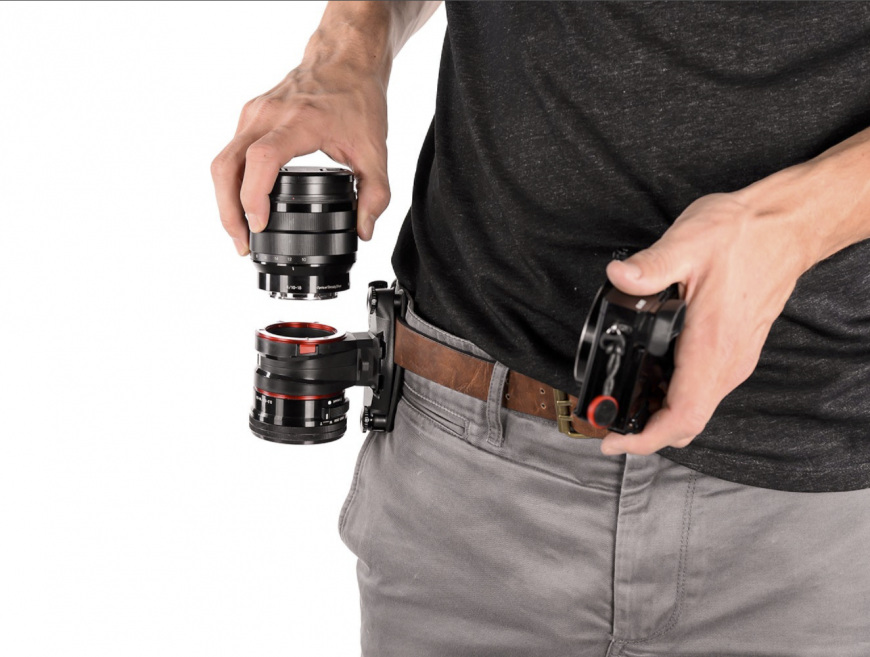
This is an attachment installed on the Capture clip instead of a camera. It lets you carry two lenses.
Source: manufacturer's materials
Apart from quick access to lenses, this is useful because people often take a camera on a Capture clip specifically to avoid carrying any backpack or bag. Then there is nowhere to put an additional lens. I did this when I was not going to walk around all day. Otherwise, I also took a backpack and attached the clip to it.
Summary
Has my attitude toward camera bags changed? Not entirely. I have always preferred backpacks because they distribute the weight across both shoulders, and I always carry more than 10 kg. But I can pack everything into this bag very practically, and whenever I look at the size difference between it and the backpack, I am shocked that everything fit. Much of that depends on the equipment I own, however. It would not work nearly as well with larger lenses.
All of this made me start thinking about the Peak Design backpack, but eventually I will certainly use a much lighter mirrorless system. Then perhaps the weight will be fine even if I pack the entire kit.
I also definitely prefer the bag when I need to take my current camera, a Nikon D810 with a grip and therefore a huge beast, and some lenses, but not all the extras I use in the studio. The Everyday Messenger works very well for me in that situation. Its unusual dividers let me arrange everything inside properly without messing around, the whole thing looks excellent, and it gives me much better access to the contents than my current backpack. I previously used a bag for trips like these too, but it had a normal construction and remained the same external size even when I used only half the space inside. In this respect, and really every other one too, I prefer the Everyday Messenger. But it costs several times as much, so it would be hard for things to turn out differently.
I heard quite a few opinions that the price was out of this world, 899 or 999 PLN depending on the size. But comments like that always appear in Poland, regardless of the price category or the quality of the equipment. The Everyday Messenger is obviously not cheap. It definitely belongs among expensive bags, while also being nowhere near the most expensive.
I happen to be one of those people who simply do not understand spending more than ten or twenty thousand zlotys on photography equipment while saving money on a backpack or bag, monitor, and so on. If it were not for that unfortunate fastener that broke on mine, I would probably write that the price matched the quality in this case :). Fortunately, the warranty is for life and apparently covers every component, so all is not lost.
The bag and all Peak Design accessories were provided by the Polish importer, peakdesign.pl.