Nikon D810 — my impressions after extended use

For several years I shot with a Nikon D700. It was great, but eventually the time came to replace it. Last year I bought a Nikon D810; so far I had only mentioned it briefly while describing my gear. It is high time I wrote something more and posted some of the photos I took with it. Alongside the retouched photographs (click a thumbnail to load the original size), you will also find RAW files here.
This will not be a camera test with photos of test charts and so on. I have neither the expertise nor the desire to do that—and autofocus speed, high-ISO performance, and the like do not matter much to me either. This post will focus on what matters to me (primarily studio photography). Besides, tests of this camera were already available at launch, so anyone interested read them long ago. I am focusing on my own highly subjective impressions.
Reasons for the upgrade
Short version: I had already wanted to replace the camera because of video and the pixel count. The D700 could not shoot video at all, and its sensor had only 12 MP. The D810 has three times as many pixels and can shoot video. My lenses also retain their full functionality because it is the same system as before.
Long version: My “I’m becoming a filmmaker” phase comes around once a year. Each time it is stronger, lasts a month, and then goes away. That is always the month when the urge to replace my camera is at its strongest. Video mattered when I chose a new camera, but it was not the most important factor. If video had been the priority, I would never have bought a Nikon; I would have bought a Sony. I would happily switch systems anyway, but that would mean replacing all my glass (to retain the functionality I have now—in other words, AF with every lens—because Nikon lenses without their own motor have no autofocus when attached to a Sony body).
And then there are the pixels: when you have plenty of them, you do not need to frame everything perfectly when taking the shot, which gives you a better chance of getting more keepers. Until now, whenever I accidentally cropped something too tightly, the photo went in the bin. I lost many good frames that way, because with beauty photography, cutting off one centimeter too much can be enough to ruin a shot. There are more advantages. The easiest way to explain them is to quote something I wrote before:
In my opinion, megapixels make almost no difference in most cases (…). But everything depends on what you need…
With photos of models, having more pixels than you need is a major advantage. Leaving aside good quality in large prints, a high pixel count on the sensor makes it enormously easier to create shots from a very short distance (beauty shots, for example, where sometimes almost the entire frame is filled by eyelids or lips). From a little over a meter away, you can take the photo with the same lens you use for a normal beauty shot and crop it; even afterward, the photograph will still be highly detailed. With 12 MP, I had to fit extension tubes (the kind used for macro photography) to reduce the minimum focusing distance and therefore get closer, filling more of the frame with the photographed feature. Otherwise, an eyelid would be only a small part of the frame, with insufficient quality for print. Getting that close also introduces perspective distortion—the eyelids become much more spherical, the nose sticks out markedly, and so on.
As if that were not enough, the shorter distance drastically reduces the depth of field, so you need to use a smaller aperture. That demands much more power from the lights and complicates everything, because instead of taking such a photo in ten seconds with the setup I had just used for full-face shots, I wasted far more time.
I also wrote there that monitors with much higher resolutions would eventually become standard. I have been using an NEC PA322UHD myself for almost a year, and I have no doubt that higher resolution will eventually catch on online as well.
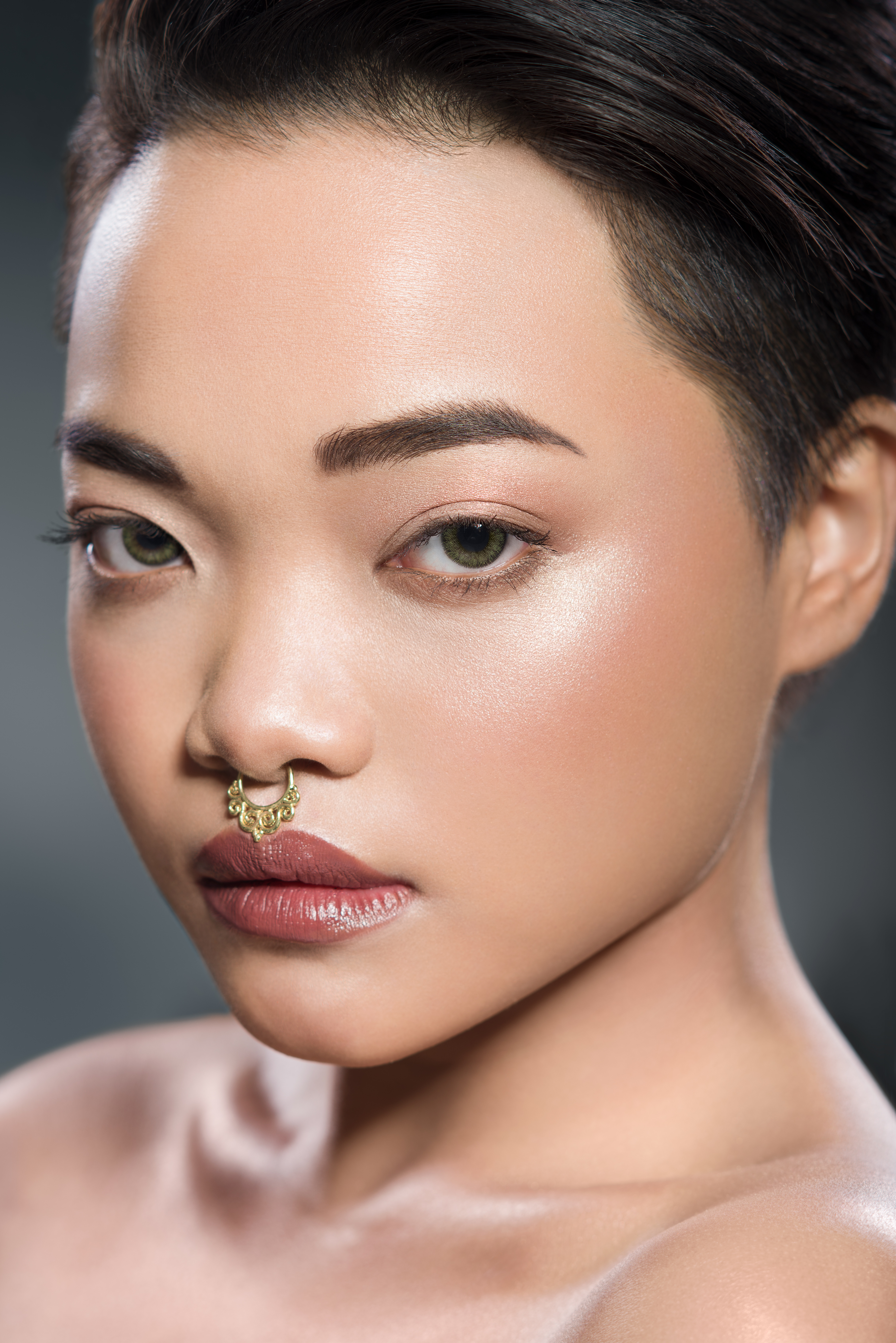
Nikon D810 | Nikkor 135mm 2D DC | F/7.1 | 1/200s | ISO 64 | RAW: Download Model: Little Patty | MuA: Patti Lu. Color-and-pattern-changing contact lenses
The D810’s biggest advantages over the D700 (and not only the D700)
36 MP sensor This is the most important change, although the sensor in the Canon 5D RS would be even better. I had previously retouched plenty of D800/D800E photos from various people, and some D810 shots too, though far fewer. To me, image quality from these cameras is very similar. I do not think any of them stands out in that respect. It is a different story when you compare them with the Nikon D700 (which has 12 MP). A severalfold difference in image size is hard to miss. One consequence is that the umbrella I use to create catchlights in the eyes no longer works as well, because when I position it to give strong light, its shape is visible too clearly in the eye. The substantial difference in image detail is obvious at a large size, but not after scaling down for the web.
With my previous camera, Photoshop never displayed a message saying it could not save a photo because the maximum PSD file size is 2 GB. At 36 MP, I have seen that warning, but it only happens with lots of pixel-filled layers. You just need to merge the layers you no longer need from time to time. I also occasionally merged the bottom layers at 12 MP, just less often.
To get any real benefit from a sensor like this, you also need high-resolution lenses. Fortunately, the lens I use most often (the Nikkor 135 2D DC) is exceptionally good in this respect. I am not sure about the others; I will eventually have to check them.
No low-pass filter Almost all cameras have such a filter to minimize the chance of moiré appearing in photos. Unfortunately, that comes at the expense of sharpness. This is why initial sharpening is applied before editing in Photoshop—it is enabled by default in ACR/Lightroom. The D800E and D810 do not have a low-pass filter, so the photos gain sharpness and the initial sharpening stage can be skipped when developing RAW files (although some people probably do it anyway). So far, I have not encountered moiré even once.
Colors Personally, I do not consider this a major advantage, because you can ultimately get identical colors from either camera. It is a fact, however, that with ACR/Lightroom’s standard settings, RAW files from the D700 looked awful—they had drastically boosted highlights and strange color casts. Changing the camera profile to D2X mode 1 or 2 fixed the problem, but people in the photos then came down with jaundice (most easily neutralized with the orange color slider). In principle, you only had to do this once and save the settings as the default, but some photos still required additional corrections.
The standard profile for the D810 gives completely different results. The photos are usable from the outset: their colors look normal and their contrast is not overdone. It is very good, though still not perfect. Unfortunately, color saturation near the shadows is still too high. Color in the shadows is a weakness of almost all cameras—or, more precisely, their profiles. Hasselblads perform exceptionally well in this respect, but medium format is a different class of equipment.
Native ISO 64 I usually eliminate ambient light entirely and do everything with flash. That is easier at a low ISO. And if the lights run out of power, I can raise the ISO.
Two memory cards Something I missed badly: an immediate data backup. One card is SD (the other is CF), so you can simply insert a card with built-in Wi-Fi and use wireless image preview on an iPad and other devices. So far, I have taken every photo with a computer connected, but I will definitely test Eye-Fi cards too, especially during outdoor shoots.
USB 3.0 It may seem obvious in 2016, but I would rather mention it. Image preview on a computer (while tethering) works more smoothly with the D810 than with the D700 (which has USB 2.0), even though the former’s files take up several times as much space. I connect my camera to a computer almost every time, so this matters.
Using the built-in screen while tethering Another difference that matters only when you work with a computer connected. On the D700, you cannot use the built-in screen while it is connected by cable. The D810 has no problem with that. So if you use software that saves photos to the computer and the memory cards at the same time, you can preview the images both on a huge monitor and on the camera screen. At least in theory, because the software I tested does not seem willing to save to two places at once (despite being configured correctly). Beyond image preview itself, the display is also useful for checking things such as the additional battery’s charge level or other settings not shown on the top LCD.
Video recording The D700 had no video recording at all. The D810 does have it, technically, but in 2016 I would expect it to be implemented much better. I do not mean the lack of 4K; I mean basic functionality, which is poor. You cannot tap the screen where you want autofocus to aim, conveniently zoom images with your fingers, or smoothly adjust focus with an on-screen slider (which would be a godsend with lenses that have a tiny focus ring and when a follow focus is not fitted). I will not go into convenient photo and video editing directly in the camera, because I would not use it anyway, but many people might find it useful.
All Nikon had to do was fit a multitouch screen (while keeping all the buttons) and adapt the firmware. Every problem above would disappear, and the difference between this generation of equipment and the previous one would be incomparably clearer. Even a phone lets you do all these things a hundred times more conveniently, despite its camera supposedly being just an extra.
Because of the ancient design built around a mirror and everything that comes with it, the whole thing is heavy enough that you cannot use most one-handed gimbals (which handle a Sony A7 without difficulty). You need to buy a larger one or choose the newest models, which cost considerably more.
There is no S-LOG color profile, which offers much greater possibilities in post-production (flat profiles are available online, but they are not as good). Autofocus during video recording also does not work with every lens. This includes my Sigma 50 mm, for example (even though it has a built-in motor). AF with the Nikkor 35 mm does work, despite that lens not having a built-in motor. You do not use autofocus at all when shooting normal films, but for vlogging it may prove essential.
None of these things makes the D810 unsuitable for video; what is more, its video quality is excellent. Video recording could simply have been implemented far better, because the necessary technology had already existed for a long time when this camera was created.
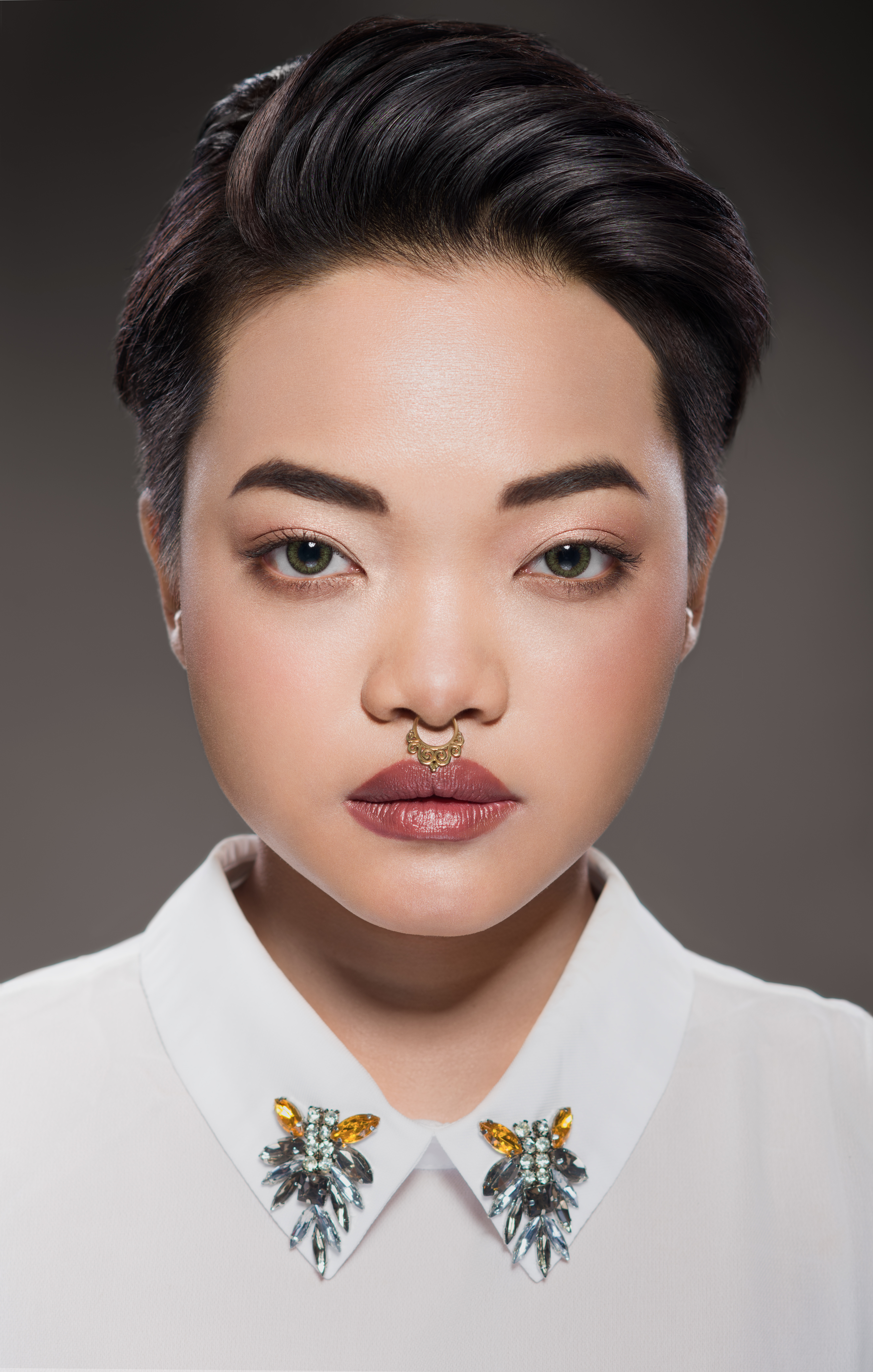
Nikon D810 | Nikkor 135mm 2D DC | F/7.1 | 1/200s | ISO 64 | RAW: Download Model: Little Patty | MuA: Patti Lu. Color-and-pattern-changing contact lenses
Drawbacks
Nikon is absolutely failing to keep up with technological progress. I have already mentioned the display. Built-in Wi-Fi is definitely missing too, although that would obviously require major changes to the construction of the entire body because it is made of magnesium. The fact that Nikon’s top cameras are still DSLRs is also a complete absurdity. DSLRs belong on museum shelves, not store shelves. If the next models have mirrors too, Nikon will end up like BlackBerry or Nokia: companies that were once powerhouses but could not understand that times were changing. Sony has already shown that a mirror is entirely unnecessary; let us hope Nikon and the rest of the competition do the same soon. That will make it possible to build cameras that are much lighter and last longer.
Photo file sizes — Photos take up too much space… I am joking, of course, but a surprising number of people make this argument. It is 2016: memory cards can hold hundreds of gigabytes, hard drives are measured in terabytes, and the cost per megabyte is lower than ever. If you run out of space, you buy another drive and that is the end of it. Compared with the cost of all the photography equipment, this is a minor expense, and in return you get quality that smaller files cannot provide. Computers have been handling files like these quite well for several years. I bought my laptop three years ago, and I edited RAW files like these on my previous computer too (from the D800, among others). People doing batch processing may be in a different situation—denoising 1,000 photos and spending several hours retouching one PSD are two completely different things. For batch-processing thousands of photos, I would simply buy a faster computer, not a worse camera. My current laptop could handle them too, just more slowly than the latest workstations.
Autofocus speed, high ISO, and everything else — These things do not matter to me, and I simply have nothing to say about them beyond the fact that they are entirely sufficient for my needs. If the autofocus points extended even farther from the center of the frame, it would be perfect.
Was the upgrade worth it?
No—if the only consideration is publishing photos online. Yes—if you take every aspect into account.
All the drawbacks I listed relate to video or usability. These things have not changed in Nikons for years, even though the technology has long allowed them to be improved. For many people, they will be completely irrelevant, but I would gladly use them.
I have no reservations about the photos themselves. Their quality is excellent, and with that, everything else becomes far less important. It is true that if I took the same photo with the D700 and D810, then edited both and reduced them to web size, there would be no chance of me telling which came from which camera. At their original size, however, the situation is different. There are also the other advantages I have already described.
As this post makes abundantly clear, I think Sony (with the A7R II) did a much better job than Nikon in many respects. Canon is developing along much the same lines as Nikon, so I did not give it much consideration.

Nikon D810 | Nikkor 135mm 2D DC | F/7.1 | 1/200s | ISO 64 | RAW: Download Model: Little Patty | MuA: Patti Lu. Color-and-pattern-changing contact lenses
Photos in more difficult conditions
I included several photos above, and earlier on the blog I described a shoot with Minty. More shoots done with the Nikon D810 will appear soon; some are waiting to be edited, while others have been finished for a long time.
Still, I ought to include something shot in the dark, without flash. I do not have many such photos, but the one below should do. It is from a birthday party where friends kept asking how it was possible to photograph anything without flash in such darkness. In reality, it was not quite that bad, because there was enough light in places, so I simply avoided the darkest areas. It is a fact, however, that I would have brought back far fewer photos with the D700. Many of these photographs are out of focus, and all of them are straight from the camera, without Photoshop or noise reduction. Almost all were taken with a Sigma 50mm 1.4 EX DG HSM. The full RAW gallery is over 6 GB, and because my upload connection is struggling, I am posting a representative file below and putting a gallery of all the photos on Dropbox as full-size JPEGs, with 8/12 compression and standard global sharpening. Every file in the gallery has full EXIF data.

Nikon D810 | Sigma 50mm EX DG HSM | F/1.4 | 1/50s | ISO 5600 | RAW: Download Full gallery | Download everything as a zip archive
I also did something resembling a night shoot, using the light from street lamps and the headlights of passing cars. I will not get to those photos for a while, though, and they will probably have a separate post.
What next?
Will my next camera be a Nikon too? If the manufacturer keeps moving in the same direction as it has so far, absolutely not. At a time when the image quality from most cameras is entirely sufficient even for professional use, other factors matter more and more. My next body upgrade will not be about gaining image quality, but usability. Every three months I have to take a trip abroad, but I have never taken my camera with me. When I have limited time to see a place, I walk around it every day from morning until night, and carrying several additional kilograms is the last thing I would consider. At most, I clip a Manfrotto lens onto my phone to change the focal length, and that is it. The image quality is different, of course, but I have never attached much importance to this kind of photography.
If the body and lenses were clearly lighter, I would probably start taking them with me. The past few decades have changed little in this respect. People said the laws of physics made it impossible to miniaturize optics. For several months now, we have known that this is not true. The first prototypes of nanolenses have been created. All that remains is to wait until they are improved and put into mass production. And before that happens, I will switch to some kind of mirrorless camera in a few years, one that will probably be much lighter.