Audio in my home office – HomePod stereo and how to buy it for half price

How the HomePod performs is probably old news by now, especially since every review repeats the same points: excellent audio for such a small speaker and very good quality for the price. This time, though, I want to look at using HomePods in my home office for music and podcasts. I will cover the pros and cons of using them there, although I have also had the chance to use them in the living room, so I will mention that too.
My computer is mainly for Photoshop, but lately I have been using it for other things more and more often too—just like in the pre-iPad days. I need music playing the whole time, but my home computer audio setup was not up to the job. At first, I only wanted something a little better than before: a fairly basic set of computer speakers for PLN 300–500, because my previous setup was the most ordinary 2.1 system, one where the words “quality” and “audio” could not honestly be used in the same sentence.
Unfortunately, by then I had nothing left to listen to music on—my music headphones had fallen apart, and I doubt I will buy another wired pair. I had never really bought speakers, either: only a very basic 5.1 system for the living room and the aforementioned, even worse 2.1 set for the computer. Before replacing my desk with a larger one, the sound also had to come from behind the monitor because there was no room on either side. Once the desk was replaced and I finally had the space, it was time to sort out better audio too.
Time for better sound
Because of its soundproofing and distance from the neighbors, my home office is the best place in my apartment for an audio system. And that is how I justified buying better speakers “for the computer” instead of the living room. In reality, they would be used almost exclusively for music and podcasts because I do not watch movies on the computer, and when I edit something, I use studio headphones rather than speakers. I only play games on a console. In other words, I could just as easily connect the new audio to a phone or tablet and get the same result. That is why AirPlay mattered to me: I wanted to switch instantly between devices at any time, including the iPad. Bluetooth would have done in a pinch, but given the choice, I strongly prefer AirPlay.
Keeping it reasonably affordable
I definitely did not want to go anywhere near truly high-end speakers; my budget could not have stretched to them anyway. So the plan was not to put some fantastic set of speakers next to the computer, but simply to get something that sounded good, made music enjoyable, and remained very compact. Anything floor-standing or requiring a separate, huge amplifier was out of the question.
My attention quickly turned to the HomePod because it has a reputation for very good sound quality, especially for its size and price. Once you factor in the discounts it can now be bought with, it is almost impossible to find an alternative without spending quite a bit more—particularly if AirPlay and such a compact size matter. At first, though, I did not realize that HomePods sometimes went on sale for $200, while refurbished units could routinely be bought for that price. So before deciding, I spent far too long analyzing whether it was really worth it and whether something else might suit me better. That is also why price will keep coming up throughout this article.
HomePod
Despite loving Apple’s operating systems, I was never convinced that its speaker was for me. Quite the opposite: I assumed it was the one Apple product I would never buy. I read all sorts of reviews, but the one that finally changed my mind was written by Miłosz Bolechowski from Fabryka Pikseli (it is behind a Patreon paywall, but as always, I encourage you to support him). Miłosz pointed out that the HomePod sounds exceptionally good even at low volume, which makes it excellent for background music. My later experience confirmed this completely. While briefly back in Poland, I bought a HomePod to hear it for myself. The shop had imported it from another country because HomePods were still unavailable in Poland, just as they were in Thailand.
The speaker from Hitech.com.pl turned out to be refurbished rather than new (the listing described it as a new product and only near the end admitted it was recertified—I reported it, and the description is no longer misleading, but it seriously annoyed me). The HomePod had three months of Apple warranty and 12 months from Hitech, neither of which was much use outside Poland. Even so, after using it in Poland for a few days, I decided not to return it. I still did not know whether it would work next to the computer or end up in the living room instead. I packed the HomePod into my carry-on and flew with it to Bangkok. If I had already known what buying used HomePods in the US was like, I would definitely have returned the one from Hitech and ordered from abroad. They were much cheaper there, even after taxes and customs, and the unit I received had more than twice as much Apple warranty left—six months. I bought mine here, but there are plenty of similar listings.

HomePod in practice
Disappointment
This article definitely will not be a love letter to the HomePod—it is not flawless. I was disappointed right at the start, not by the sound quality but by the volume. Everywhere I looked, people said it was surprisingly loud, so my expectations were huge. In reality, the HomePod plays exactly as loudly as I would have expected without reading about it. It is loud, but the windows do not rattle, plaster does not fall off the walls, and the neighbors do not even call the police. Shame.
Satisfaction
The sound quality itself really is very good, even without making allowances for the speaker’s size. It could be several times larger and I still would not expect better sound, only more volume. Even when set to barely a dozen or so percent, the separation between individual instruments and the clarity of the vocals are hugely impressive. In fact, that is when it is most astonishing, because I would normally expect it only from large floor-standing speakers. A single HomePod also sounds distinctly better than my 5.1 living-room system (which cost about as much as two HomePods bought at the best sale prices—so it is absolute low-end, because a good 5.1 system costs several times more, but this is still five speakers and a subwoofer against one 17-centimeter-tall speaker). Incidentally, everyone expects the speaker to be larger after seeing it in photos. The HomePod is genuinely surprisingly small. What surprises people even more is its weight once they lift it after seeing that tiny size. It is unbelievably heavy for its dimensions. EVERYONE who picks it up says the same thing: “Jesus, this is heavy”—and, as it turns out, that even applies to airport security… Contrary to my fears, however, nobody mistook it for a bomb, which used to happen regularly when I traveled with a projector.

Back to the sound: the HomePod also sounds better than my music headphones driven by an AudioQuest DragonFly Red, even before they fell apart. Perhaps that should not be surprising when comparing a speaker with “mere” headphones. But audio publications around the world had compared that model with sizable loudspeakers, and just a few years earlier there was no question of speakers costing PLN 1,000 or 2,000 matching them. Their sound was always too neutral for me, though, so perhaps I simply prefer a different sound signature. Apple’s speaker is not neutral—the bass is pronounced, but not enough to get in the way. The HomePod contains quite a lot of electronics devoted to processing the audio and making it sound much better than it has any right to. You can see that in measurements, but while listening there is absolutely no sense of distorted audio, only sound that is too good to seem possible from something this small. I used to aim for neutral audio, but I now know it is not for me, and I welcome a little enhancement with open arms. The HomePod’s bass is strong, but of course a large additional subwoofer in the room would improve things, because at maximum volume the low end is less impressive than it is at lower levels.
I do not have a favorite kind of music—I listen to everything, and it has always been the case that some tracks sounded good on a particular setup while others clearly needed a different speaker or headphone signature. I do not feel that at all with the HomePod. I have never thought the vocals should be clearer or the low end less boomy. I remember buying my first headphones that were a little better than supermarket models years ago and discovering that the music I listened to contained far more instruments than I had heard before. With the HomePod, all those instruments remain audible regardless of the volume. I should add that I do not listen to FLAC files, only ordinary streaming, so this is completely casual listening. It is usually Spotify, and the result is already this good there. I did once start the free version of Spotify, and it was immediately obvious that something was wrong: the sound resembled an old radio or the cheapest computer speakers, and the instrument separation I mentioned was gone. When the source quality is terrible, no miracles are possible. As long as the audio meets even a minimum standard, though, it becomes genuinely good.
Some people say the HomePod cannot sit on the same desk where you work because it causes too much vibration. They use damping pads or put the speaker elsewhere. I can feel vibrations from the HomePod through my hands, but they are so slight that they do not matter. My hands are never directly on the desktop anyway; they rest on a pen tablet, which adds another layer of damping. I might use some pads one day, but not because I need them.
Besides music, I play a lot of podcasts, and not all of them are recorded under studio conditions. I always avoided listening to them through bass-heavy headphones or speakers because at high playback speeds they become very muddy—to the point that I would rather use the phone’s built-in speakers. That problem disappears with the HomePod; conversations remain very clear.
Something is missing
Despite all the drivers inside the HomePod, one speaker cannot produce stereo, and I missed it. The HomePod could fill the entire living room with music and worked brilliantly there, but beside the computer I badly missed a second speaker. I could always hear the sound coming from the right side of the screen and felt the lack of stereo. In the living room, the speaker’s position barely mattered to me; it sounded fine wherever I put it. Up close by the computer, it did not perform quite as well. Placing the HomePod in the center was impossible because of the monitor, and when I put it on the floor behind me, the result was slightly worse than on the desk (I generally think it sounds better when it is not very close to the floor). So I started thinking about moving it to the living room and buying a decent stereo system for the computer. The other option was to add a second HomePod and pair them in stereo.
HomePod stereo?
People say that with the HomePod, 1 + 1 does not equal 2 but 11. Having heard it for myself, I fully agree—the second HomePod makes an enormous difference. Much more than you might expect, and until you hear it, every claim like this will sound exaggerated. Since every owner of two HomePods I encountered was delighted with them, I decided to buy another one, but mainly for economic reasons: adding a second HomePod was much, muuuch cheaper than buying two speakers that would outperform the pair, especially since I already owned one.
The calculation
If I had convinced myself to spend more, I would probably have ended up with another audio system that could play louder and sound better overall. But I wanted something that delivered a good result without dragging me into much higher costs. You know how it goes: the smaller each improvement in quality becomes, the more you have to pay for it, and once you compare it with a refurbished HomePod, the price difference becomes enormous. On the other hand, with a system even slightly cheaper than a HomePod, the drop in quality is so large that it makes little sense. Especially once I had become used to this kind of sound; otherwise, perhaps a Bose computer speaker set would have been enough for me (I mention it because a surprising number of people recommended one before I raised my budget). A HomePod costs $200–500 including shipping and taxes, depending on where you buy it and whether it is completely new or recertified. That is a huge price range. There is no shortage of refurbished HomePods in like-new condition, which does not surprise me: if I had bought this speaker hoping to talk to it the way you can talk to Alexa, I would have returned it immediately. Until Siri gets smarter, I will continue using it only for reminders, the calendar, and occasional smart-home control. Just six months ago, anything slightly below PLN 1,400 was considered a great deal in Poland, and it was very difficult to find comparable quality at that price. Recently, however, both colors—black and white—have regularly appeared below PLN 1,000 on the Polish branch of iBOOD, and a few days ago they were… PLN 870!!! As always with that store, though, the offer lasted only one day.
I already had half the system, while switching to different audio would have meant assembling everything from scratch, so after a few days with the first HomePod, the decision to buy a second was settled. I imported the second unit from the US for PLN 1,100, including shipping to Bangkok and taxes paid in advance. Had I lived in the US or brought it back myself, it would have cost only $200. I keep mentioning the price because buying good speakers for a lot of money is easy. What the HomePod offers at full price is excellent; at the refurbished price, it is incredible.
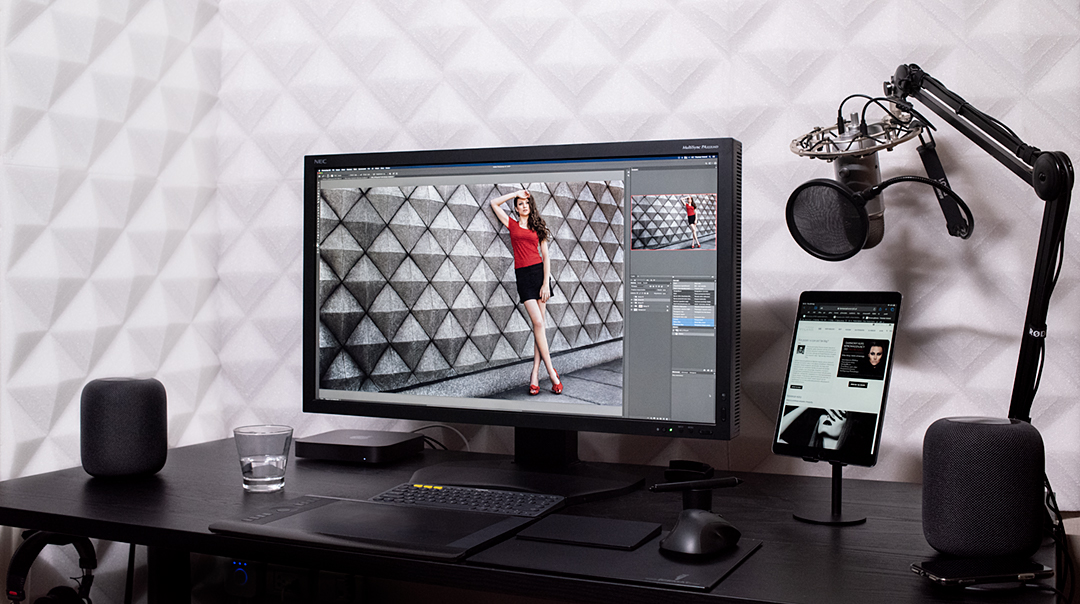
Everything people say about stereo with HomePods is true—it gives the sound an enormous boost. I also swear that in a great many songs—almost all of them, in fact—the vocals do not seem to come from the speakers beside the monitor but from the wall in front of me. If I had not put my ear right against a HomePod, I would have been convinced there were additional speakers behind the monitor. I thought it was impossible for sound to spread that way from only two speakers. If I had more room at the sides, I could easily place them much farther apart without ill effects. The 360-degree design probably deserves much of the credit because it also directs sound toward the wall behind the monitor. I do not get the impression that sound also comes from behind me, however (although I have seen people claim that). It feels like listening to stereo with extra speakers directly in front of me, not surround sound. That does not bother me with music, but for movies I would definitely prefer audio from every direction. More HomePods could do an even better job, but for now only stereo is supported, not 3D sound.
To sum up the sound quality, two HomePods were an enormous upgrade over my previous setup. I am 80% satisfied with their quality. The remaining 20% is not so much about the sound itself as the maximum volume and the lack of the same strong “wow” effect at higher levels. The stereo pairing genuinely works brilliantly, though, and the problem is that if I now wanted another HomePod for the living room, I would probably buy it with a second one because the difference is so dramatic.
I have not said much about Siri because I need it far less in the office than in other rooms, but the HomePod’s microphones never stop amazing me. You can play music at maximum volume, speak to Siri without shouting, and it hears everything. I have seen even more extreme examples: while sitting in the living room with a movie playing fairly loudly, I told my watch to do something, and the speaker heard me from another room behind a closed door. The watch immediately stops listening for the rest of the command in that situation, so there is no risk of one instruction being carried out twice. At the computer, I mainly use Siri to change the volume. The only thing that annoys me is that when I raise it near the maximum, Siri asks me to confirm that I really want it that loud. There should be a way to disable that.
Apple being stupid
Siri’s stupidity is almost unbelievable, but most people know by now that she is Alexa’s dimmer, not entirely all-there sister.
Unfortunately, HomePod support on the Mac will also remain badly crippled for a while. My computer is running Mojave, not the Catalina beta. Unfortunately, Mojave cannot connect to HomePods paired in stereo (except through iTunes). I use Spotify, so I simply connect from my phone, which has no such limitation. Spotify on the computer can then control the music just as if it were playing directly from the Mac, so the audio source makes no difference to me. Things are worse when I want to watch something on YouTube: then I am left with a single HomePod, which annoys me because I sometimes work in Photoshop while playing a vlog. If I do that directly on the computer rather than on an iPad placed beside the monitor, I have to choose whether the sound comes from the left or right speaker. On top of that, audio sent from VLC, for example, lags behind the picture. I am not talking about the delay you get with poor Bluetooth headphones, but one or two full seconds! The same thing happened when I finally decided to play Pillars of Eternity on the computer. WTF, Apple!? I mentioned that I do not watch movies in the room with the computer, but I do edit my webinars there, for example. If I did not use headphones for that, I would have no way to edit even a simple recording of a live video. In that situation, the HomePod is absolutely no alternative to ordinary computer speakers.
As far as I know, AirPlay in macOS Catalina works just as well as it does on iOS, so I will probably add a paragraph about it here in a few weeks. When I bought the HomePods, I knew that only the next operating system would let them function normally, but I had hoped I could at least send sound to both HomePods simultaneously, even if only in mono. No such luck.
The version of iOS used to send music over AirPlay also mattered. On iOS 12, the two speakers regularly fell out of sync. Only the iOS 13 beta fixed it (although it depended on the app: Spotify worked perfectly, while Overcast still sometimes lost sync when resuming podcasts. Switching the sound to the iPhone and back fixed it, but it should not have been necessary). I should add that my Wi-Fi was solid.
Flaws of the current generation
I would seriously consider adding HomePods to the living room in place of my current poor home-theater system (but as I said, it would absolutely have to be at least two HomePods in stereo because, as the old Thai proverb goes, once you have stereo, you never go back to mono). The problem is that AirPlay is the only way to connect a HomePod. How am I supposed to connect my game consoles that way!? I could use Apple’s speakers only for movies and would have to keep a separate audio system for games. Not happening. I once told myself that I would never buy another 5.1 system and would replace it with a very good Dolby Atmos soundbar. Now I might consider spending the same money on a whole set of HomePods, except that the connectivity limitations make that pointless. It would also be good if Apple introduced surround sound in the future so that you could completely surround yourself with audio. That would be most useful in the living room for watching movies.
Summary
As you can see, HomePods are not perfect. For music alone, I am very happy with them, and once you account for the prices at which refurbished units can now be found, anyone will be delighted with how they spent the money. I cannot see any way it could be otherwise. And I am saying this as someone who, until now, has been disappointed by the sound of almost everything—certainly everything at this price. The HomePod also has several useful features that become especially handy when you have them in different rooms or run the latest software on the HomePod itself. Unfortunately, I will not get that until the official release. In any case… as you move between rooms, one command can transfer the music currently playing to the room you enter. In the future, you will also be able to bring your phone close to the speaker and automatically hand off whatever is playing—without buying separate NFC tags and creating automations for them.
For those reasons alone, I would love to have HomePods in every room instead of the Bluetooth speakers I currently use. So will I buy more? No. I am waiting for the next generation, which may eliminate these flaws; if it does not, I will decide what to do then. Prices are falling so quickly that at some point it will become impossible to justify not buying them despite every flaw in the current generation. If a refurbished unit appeared for $150 including tax, it would be impossible to resist—especially since privately imported units still sell for more than PLN 1,200 in Thailand, meaning I could even make money on my current US HomePod.
When I want even better office audio in a few years, I will definitely look at solid but compact stereo systems. Before buying the second HomePod, for example, I was strongly tempted by the KEF LSX speakers after reading opinions and watching reviews. They are certainly better than two HomePods; the only question is whether they are worth several times the money. There is a shopping mall next to my apartment with all sorts of audio shops, so every day on my way to breakfast, I passed hundreds of speakers, including those KEFs. Even so, I decided not to audition them because I know how that might have ended. I will return to the subject in a few years and decide what comes next.